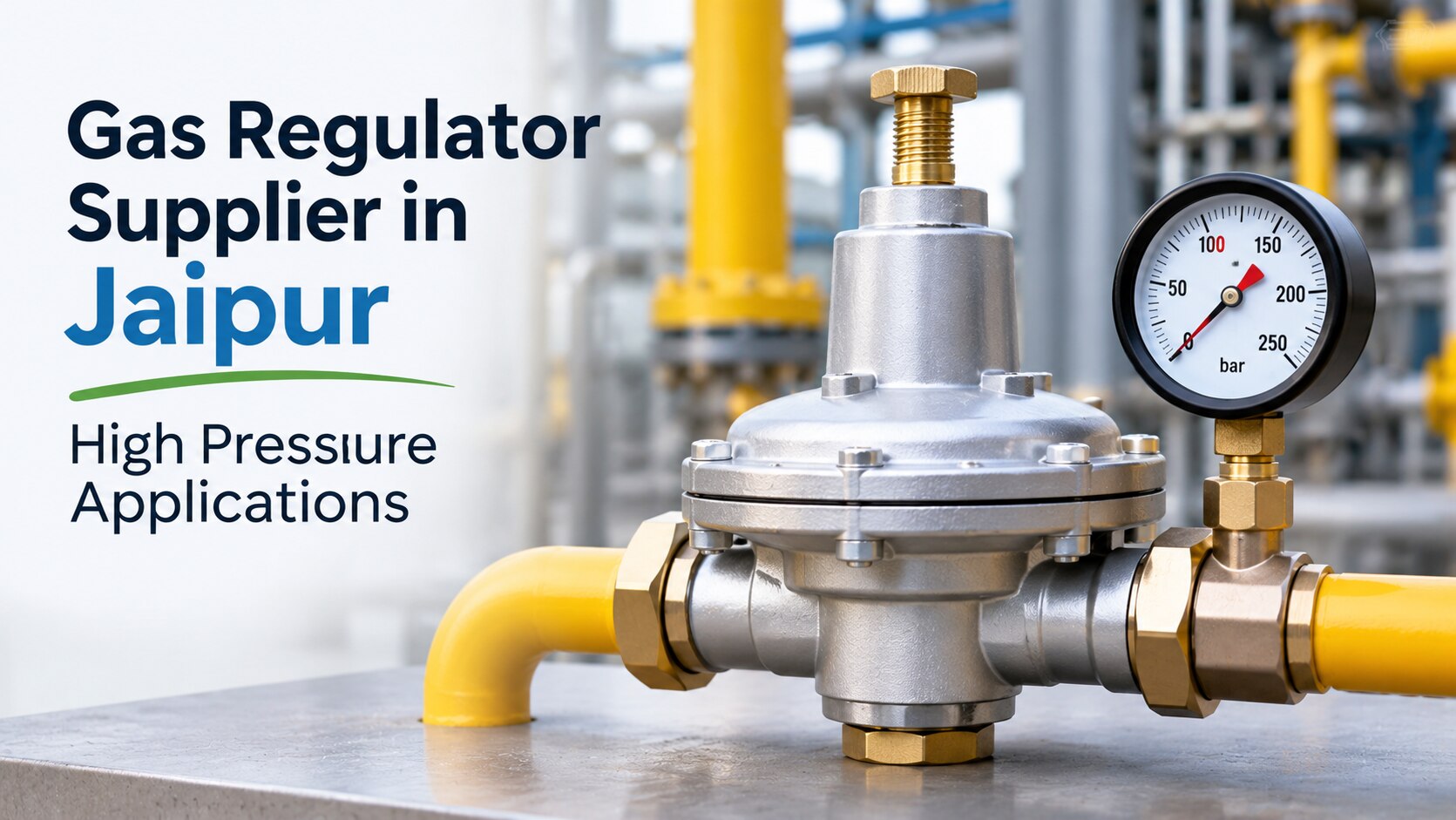
Choosing a regulator by cylinder pressure alone can leave you with the wrong outlet range, unstable delivery, incompatible materials or an unsafe connection. By the end, you will know how to define the pressure and flow requirement, match the regulator to the gas and installation, and compare a Jaipur supplier’s quotation on evidence rather than price alone.
Key takeaways
- Choose two-stage regulation when outlet pressure must stay steady as the cylinder empties.
- Compare inlet pressure, outlet range, flow rate, droop and relief settings.
- Match diaphragm, body and seal materials to the gas and required purity.
- Ask for licences, test certificates, traceability records and after-sales support.
Choose the regulator stage and device for the job
Choose a single-stage regulator for cylinder, manifold or process service when outlet-pressure drift as cylinder pressure falls will not affect the process. Choose a two-stage regulator when delivery pressure must remain steadier across the cylinder’s usable life.
| Stage | Choice | Best fit |
|---|---|---|
| Single-stage | Simple pressure reduction; outlet pressure can drift as inlet pressure falls | Cylinder, manifold or process service that tolerates drift |
| Two-stage | More stable delivery as cylinder pressure declines | Analytical gases, calibration work, laboratory instruments and pressure-sensitive processes |
A regulator reduces pressure; it does not measure or precisely control flow. Use a flowmeter for visible flow indication, a needle valve for basic manual throttling, and a mass-flow controller for setpoint-based flow control. Use a pressure-reducing valve to lower pressure within a system, or a back-pressure regulator to hold upstream pressure.
A flowmeter or needle valve is not a safe substitute when the installation starts with high cylinder pressure.
When requesting an industrial gas regulator in Jaipur, specify the complete protection arrangement:
- Add a correctly sized relief valve or regulator relief device when downstream equipment requires overpressure protection.
- Do not treat the regulator’s outlet setting as its shutoff capability.
- State the required delivery pressure and flow together; flow demand affects outlet-pressure stability.
- Ask a gas regulator supplier in Jaipur to identify whether the proposed device suits continuous, intermittent or analytical service.
Read the pressure, flow and performance data before buying
A nameplate, process specification or gas-chromatograph method gives you the data needed to define a regulator. Do not write “high-pressure model” and leave the supplier to guess; convert the operating requirement into separate pressure, flow and performance values.
- Record the cylinder’s filled pressure separately from the regulator’s certified maximum rated inlet pressure. They are not the same rating. Then state the required outlet-pressure range, plus the inlet and outlet gauge ranges.
- State the required flow at the specified delivery pressure and identify the duty: continuous, intermittent, low-flow analytical or high-flow demand. Ask whether the quoted capacity uses standard litres per minute, actual litres per minute or another reference condition; unqualified figures cannot be compared.
- Request rated flow, temperature range, proof-test pressure, droop and lock-up pressure. Droop is the outlet-pressure fall as demand increases; lock-up is the pressure reached when downstream flow stops.
- Require a nameplate or datasheet showing gas service, pressure units, body and diaphragm materials, certified maximum working pressure and relief design. Add a relief valve or regulator relief device when downstream equipment needs overpressure protection.
For gas regulator specifications in jaipur, send this completed data with the equipment model or method number. It gives the supplier a testable requirement instead of an ambiguous request and exposes capacity, compatibility or protection gaps before purchase.
Match wetted materials and connections to the gas
Material compatibility comes before pressure rating: an industrial gas regulator in Jaipur rated for 300 bar is not automatically suitable for oxygen, chlorine or hydrogen sulfide. Match the body, diaphragm, seat, seal and bonnet to the actual gas, then obtain the manufacturer’s compatibility and leak-test documentation.
- Oxygen: specify oxygen-clean regulators and fittings, free from oil, grease and hydrocarbon contamination. Ordinary industrial construction is not oxygen-compatible merely because its pressure rating is adequate.
- Nitrogen and argon: confirm the proposed metals and elastomers, rather than assuming materials suitable for one inert gas suit every service.
- Flammable gases: verify seal compatibility, ignition controls, electrical bonding and leak-test criteria.
- Corrosive, toxic or reactive gases: request documented materials compatibility, diaphragm or bonnet configuration, venting arrangements and allowable leakage.
- Hydrogen and helium: identify elastomer type, fitting design, connection type, leak-test method and maximum permitted leakage because small molecules escape through poor seals.
- Mixed gases: obtain compatibility confirmation for every component against the complete mixture, concentration and moisture specification.
For high-purity or analytical service, ask for diaphragm-sealed, low-dead-volume construction, passivated or electropolished stainless-steel wetted parts and a documented cleaning record. Brass can be unsuitable even when its pressure rating passes; a high purity gas supplier in Jaipur should state the material and cleaning basis.
Confirm the cylinder-valve connection, gas-specific connector, outlet connection, thread standard and any left-hand thread. Ask whether each connection follows CGA, DIN, BS, ISO or another named standard. Never fit an adapter that defeats a keyed or non-interchangeable gas connection.
Check installation, service category and statutory safety controls
Before installation, classify the duty as cylinder, manifold, laboratory, medical or process service; the same pressure rating does not make regulators interchangeable.
| Service | Check before installation | Failure if mismatched |
|---|---|---|
| Cylinder | Inlet connection, maximum inlet pressure and outlet range | Cross-connection or overpressure |
| Manifold | Continuous-duty heat rise, stability and spare-part support | Drift, overheating or difficult maintenance |
| Laboratory | Low-flow control performance and leak data | Unstable readings or contaminated results |
| Medical | Medical-gas intent and ISO 10524-1 applicability | Unsafe equipment treated as industrial |
| Process | Capacity at the actual outlet pressure | Pressure collapse at demand |
Ask a gas regulator supplier in Jaipur to document the duty, not merely label the product “high pressure.” For intermittent draw, confirm response without excessive overshoot. Medical gas regulators are a distinct category; a general industrial regulator is not an equivalent substitute.
Secure the cylinder upright, fit the correct connection with the specified wrench or hand connection without force, and open the valve slowly while standing clear of the regulator face. Slow opening limits rapid pressurisation and adiabatic heating, which matters especially in oxygen service.
Define a vent route for toxic or corrosive gases and discharge it away from occupied areas. In India, verify compatibility with the Gas Cylinder Rules and applicable Petroleum and Explosives Safety Organisation requirements. An invoice proves purchase, not statutory compliance.
Compare a Jaipur supplier’s quotation on traceability and support
Ask a gas regulator supplier in Jaipur for a line-by-line technical quotation, not a price for a “high-pressure model.” Use this request:
- Gas service; maximum inlet pressure; outlet adjustment range; rated flow with reference conditions; inlet and outlet connections; thread standard; temperature range; wetted materials; diaphragm and seal materials; relief arrangement; proof-test pressure; and serial number.
- For high-purity gas, add purity grade, certificate of analysis or batch documentation, cylinder treatment, residual-gas policy, cleaning record and regulator material declaration.
- Request calibration or test records, serial-number traceability, spare diaphragm and seal availability, warranty terms, leak-test evidence and a defined after-sales response.
| Quotation basis | Complete technical package | Weak quotation |
|---|---|---|
| Gas and pressure | Names the gas, maximum inlet pressure and outlet range | Says only “high pressure” |
| Flow | States flow in SLPM, ALPM or another reference condition | Gives an unqualified flow figure |
| Traceability and support | Identifies serial records, tests, spares, warranty and response time | Offers price and delivery only |
Compare like this:
A high pressure gas regulator supplier in Jaipur should separate cylinder pressure from delivery pressure and state proof-test and leak-test evidence. A high purity gas supplier in Jaipur should document the gas and cleaning history; stainless steel alone proves neither purity nor compatibility.
Dinesh Gases can add value when its industrial, laboratory and medical gas capabilities and associated gas-handling equipment are assessed against this checklist. Choose the quotation that documents your gas, pressure, flow, connections and service duty, even when another bid is cheaper.
Related products
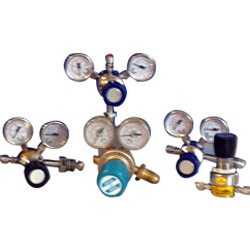 | HIGH PRESSURE REGULATORS ₹3000 We are Authorized Distributor of Branded Company for wide range of gas regulators which play an important role in our daily operations of gas... View product → |
 | AUTOMATIC GAS MANIFOLD AUTOMATIC & MECHANICAL GAS CHANGE OVER SYSTEM ₹125000 FEATURES: Standard Audio visual Alarm Check Valves to prevent discharge of gas from pigtails when changing cylinders SS braided of 1 m length for... View product → |
Frequently asked questions
When should you choose a single-stage or two-stage gas regulator?
Choose a single-stage regulator when outlet-pressure drift as cylinder pressure falls will not affect the process. Choose a two-stage regulator when delivery pressure must remain steadier across the cylinder’s usable life.
Which gas regulator specifications should you compare before buying?
Compare maximum inlet pressure, adjustable outlet-pressure range, rated flow, pressure droop, relief-valve setting, temperature range and connection type.
How do you match a regulator to the gas?
Check the gas compatibility of the body, diaphragm, valve seat, seals and connections. Use materials and cleanliness suitable for corrosive, oxidising, toxic or high-purity gases.
What should a Jaipur supplier include in a regulator quotation?
Request the exact model, pressure and flow ratings, materials, connections, test documentation, batch or serial traceability, installation scope, warranty and service terms.
Keywords