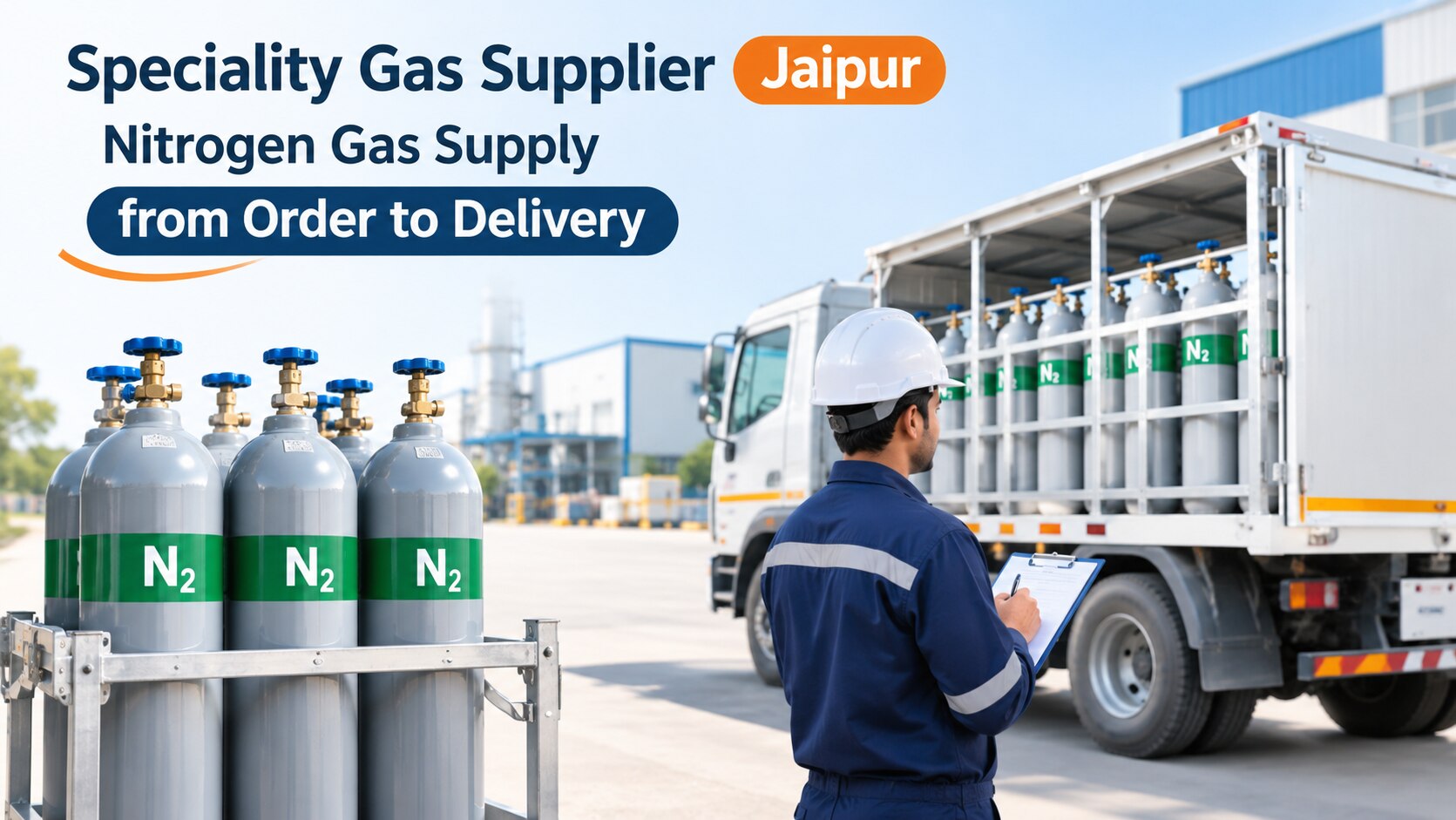
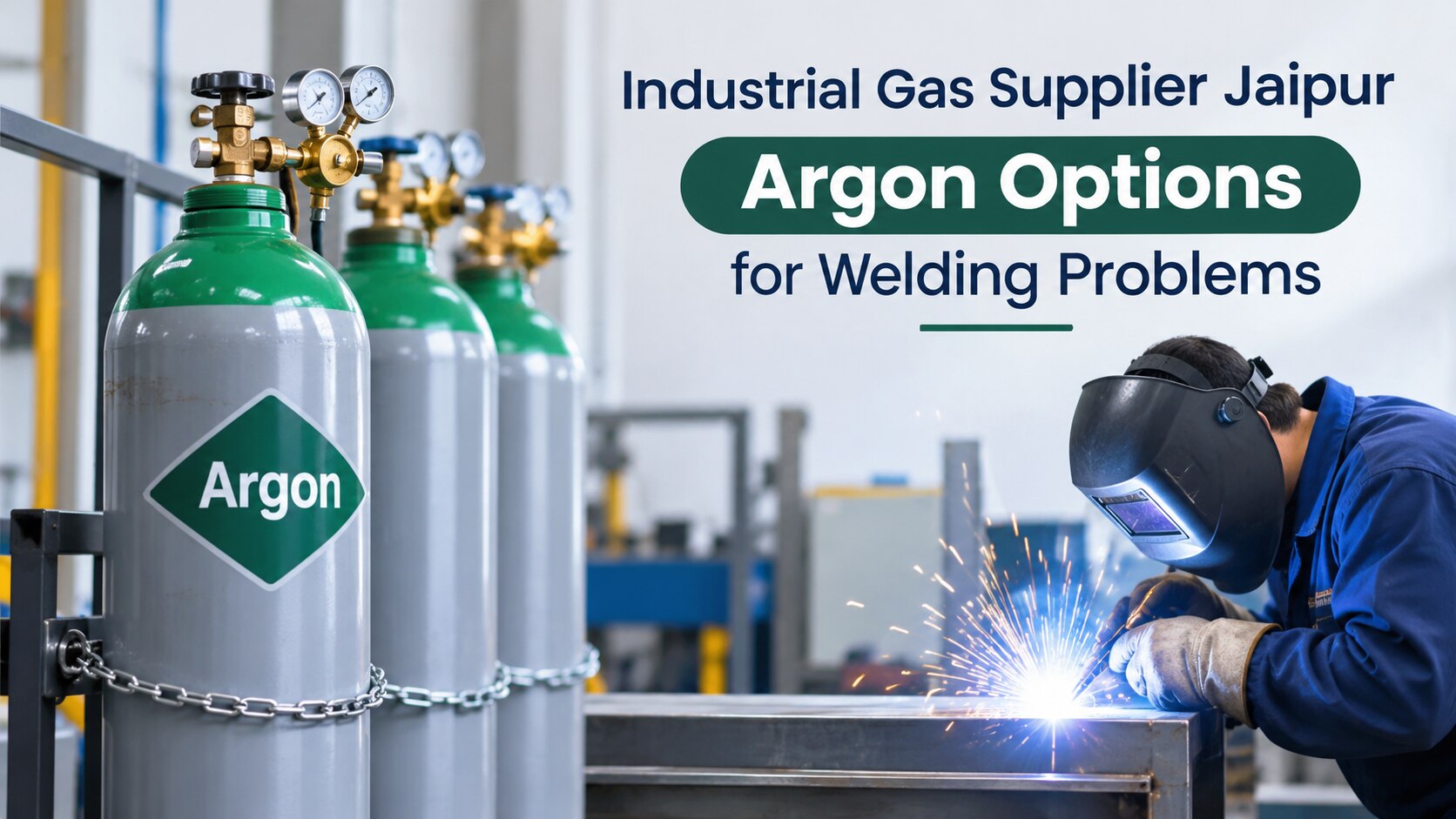
Porosity, oxidation, an unstable arc and discoloured stainless steel welds do not automatically mean the argon is poor. By matching the gas classification to the process, checking the cylinder and delivery equipment, and correcting flow and shielding conditions, you can identify whether the fault lies with the gas supply or the welding setup.
Key takeaways
- Use pure argon for TIG, orbital welding and aluminium MIG.
- Compare purity, batch records, cylinder test dates and delivery terms.
- Check leaks, drafts and flow before blaming argon for weld defects.
- Choose a supplier with tested cylinders and dependable replenishment.
Which Jaipur welding processes need pure argon, and which need a mixture?
Pure argon is normally the right starting gas for TIG/GTAW, orbital welding and back-purging, plus MIG/GMAW on aluminium, magnesium, copper and many stainless-steel grades. Under ISO 14175, pure argon is classified as I1.
| Process | Usual gas choice | Why |
|---|---|---|
| TIG/GTAW | Pure argon, I1 | Stable arc and clean shielding |
| Aluminium or magnesium MIG/GMAW | Pure argon, I1 | Supports spray transfer and avoids excessive oxidation |
| Copper and many stainless-steel MIG jobs | Pure argon or a specified mixture | Depends on thickness, transfer mode and bead requirements |
| Orbital TIG and stainless back-purging | Pure argon, I1 | Protects the tungsten, root and heated metal from air |
| Carbon-steel GMAW | Argon–CO₂ or argon–O₂ mixture | Improves arc stability, wetting and bead profile; pure argon can produce an unstable arc and poor fusion |
Do not order only “argon.” Tell an industrial gas supplier for argon in Jaipur whether the cylinder is for welding, orbital work, back-purging, instruments or another use. Ordinary welding grade suits routine fabrication; instrumental or high-purity argon is justified when trace contamination could affect analysis or a high-integrity weld.
Request the certificate of analysis or batch specification, including impurity limits for moisture, oxygen and hydrocarbons. A quoted “99.999%” does not prove those limits. Ask an industrial argon gas in Jaipur provider to state the ISO 14175 class, grade and end use on the order.
What cylinder and gas documents should you compare before ordering?
Before comparing prices, ask an argon cylinder supplier in Jaipur for the cylinder’s water capacity, usable filled-gas volume, service pressure, tare weight, valve type and connection standard. Check the stamped cylinder identification and confirm the test or hydrostatic-examination date is current.
Request a certificate of analysis or batch specification stating purity, moisture, oxygen and hydrocarbon limits.
Cylinder ownership changes the real price and responsibility:
| Option | What it means | What to compare |
|---|---|---|
| Owned | You purchase and maintain the cylinder | Testing, refill, transport and replacement responsibility |
| Rented | Supplier retains ownership | Rental period, damage charges and refill terms |
| Deposit-based | You pay a refundable security amount | Deposit refund conditions and deductions |
| Exchanged | You receive a tested full cylinder for an empty one | Exchange fee, residual-gas treatment and availability |
| Disposable | Cylinder is not returned for refill | Gas volume, disposal route and waste cost |
A larger cylinder reduces changeovers but needs more storage space, lifting control and reserve planning. A single large cylinder can also stop production longer if replacement is delayed; ask about delivery lead time and emergency replacement.
Include these charges and terms in writing:
- Gas price, GST, transport and regulator or manifold charges
- Refill versus exchange procedure and minimum order
- Rental or deposit amount
- Treatment of residual gas returned
- Compatible valve connection and hose materials
Pressure varies with temperature, so a high gauge reading does not prove purity. Use the identification, test status and batch documents instead. Store cylinders upright with valve protection, as required by India’s Gas Cylinders Rules.
How do you tell an argon-related weld defect from a welding error?
Porosity, black or grey tungsten, unstable arcs, excessive spatter, stainless-steel oxidation, poor aluminium cleaning and weld discolouration do not prove bad argon. They first point to air entering through a leak, blocked diffuser, poor torch angle, inadequate pre-flow or post-flow, contaminated tungsten, dirty base metal, incorrect polarity or an incorrect regulator setting.
Low or contaminated shielding becomes more likely after those checks pass.
A certificate and stated purity do not prevent air entrainment inside a leaking torch, cracked hose or loose connection. For argon welding gas in Jaipur, ask for the certificate of analysis or batch specification, but diagnose the delivery system before rejecting a cylinder.
1. Inspect the weld and tungsten. Match the symptom to oxidation, contamination, poor aluminium cleaning or excess heat rather than assuming gas failure.
2. Confirm the process, polarity and regulator setting. Pure argon suits TIG and many aluminium applications; carbon-steel GMAW needs the specified argon mixture.
3. Check the diffuser, cup, tungsten fit and torch angle. Look for blockage, spatter, cracks and a damaged gas lens.
4. Purge the hose and torch after cylinder changeover, then check the cylinder connection, regulator inlet, hose ends, solenoid and torch with an approved leak-detection method. Long or undersized hoses can also starve shielding.
5. Test gas delivery with a sound regulator and flowmeter. If flow remains low or contaminated after these checks, compare the cylinder batch and specification before removing it from service.
What flow rate, leak checks and wind controls protect the shielding zone?
Start at 8–15 L/min for TIG and 12–20 L/min for many GMAW setups, then adjust from evidence rather than turning the knob until defects vanish. A larger cup or gas lens, higher current, thicker material, restricted joint access or a withdrawn torch can change the required flow.
1. Confirm the units before setting the regulator. One L/min is approximately 2.12 CFH, so a reading of 10 on a CFH scale is not 10 L/min. Set adequate pre-flow, purge the hose and torch after a cylinder change, and inspect the diffuser, cup and tungsten.
2. Check for leaks at the cylinder valve connection, regulator inlet, hose ends, solenoid, torch connection and fittings. Use an approved leak-detection method; never rely on a full cylinder to prove sound delivery. Excessive flow creates turbulence that draws room air into the shield, while insufficient flow causes porosity and oxidation.
3. Control draughts with wind screens and local shielding around the joint, especially outdoors or near fans. Keep the torch angle and stand-off stable, and position the cup close enough for coverage without touching the work. High flow alone can worsen turbulence.
4. Before accepting a cylinder from an argon gas supplier in Jaipur, stop using it if the valve is damaged, the protective cap is missing or the test date has expired. Check the regulator, hose and fittings for compatibility with argon service; do not improvise adapters.
How should you choose an argon supplier for reliable welding continuity?
Specify the service before comparing prices. An industrial gas supplier for argon in Jaipur should quote a regulator rated for argon and cylinder pressure, the correct valve connection, and hose materials compatible with argon service.
Do not assume oxygen-service components fit, or use an improvised adapter: the wrong connection can cause leaks, contamination or an unsafe regulator mismatch.
| Option | Specification focus | What to write on the order |
|---|---|---|
| Welding argon | ISO 14175 shielding-gas classification, commonly I1 for pure argon | Process, purity, moisture and oxygen limits, and certificate of analysis |
| Laboratory argon | Defined impurity profile and batch traceability | Analytical grade, limits for hydrocarbons, oxygen, moisture and other required contaminants |
| Medical gas | Controlled medical-gas specification and documentation | Intended medical use; never substitute a welding cylinder |
Write the end use clearly. A quotation for industrial argon gas in Jaipur should state gas classification, impurity specification, cylinder water capacity, filled volume, valve standard, test status, ownership or rental, refill or exchange terms, delivery, GST, deposit and residual-gas treatment.
Require legible cylinder markings, a current periodic examination under India’s Gas Cylinders Rules, 2016, valve protection, secured upright transport and compliant storage. Pressure does not prove purity; temperature changes the gauge reading.
Dinesh Gases can be considered when you need purity-certified gas, cylinders, gas-handling equipment or documented delivery; ask the argon gas supplier in Jaipur to state replacement arrangements in writing.
Related products
 | ARGON CYLINDER ₹1200 We supply all types of normal to Instrumental grade Argon gas, which is available in an unadulterated form. View product → |
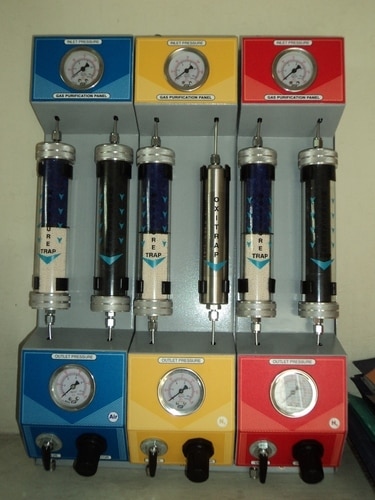 | INSTRUMENTAL GAS ACCESSORIES GAS PURIFICATION CUM CONTROL PANEL ₹12500 We provide Gas Purification and Control Panel that is available in different specifications to meet the requirements of varied industry applications. View product → |
Frequently asked questions
Which Jaipur welding processes need pure argon, and which need a mixture?
Pure argon, classified as I1 under ISO 14175, suits TIG/GTAW, orbital welding, back-purging and MIG/GMAW on aluminium, magnesium, copper and many stainless-steel grades. Argon-carbon dioxide or argon-oxygen mixtures suit many carbon-steel and low-alloy-steel MIG applications because they influence arc stability, penetration and spatter.
What cylinder and gas documents should you compare before ordering?
Compare the gas grade, stated purity, fill pressure, cylinder serial number, batch or lot number, filling date and cylinder test or inspection marking. Request the supplier’s certificate of analysis or conformity document and confirm that the cylinder valve, seal and label match the delivery note.
How do you tell an argon-related weld defect from a welding error?
Suspect shielding trouble when porosity, oxidation, blackened tungsten or inconsistent arc behaviour appears with correct settings. Check hose and regulator leaks, torch connections, gas flow, cup size, tungsten condition, torch angle and drafts before replacing the gas.
What flow rate, leak checks and wind controls protect the shielding zone?
Set flow according to torch cup, joint geometry and procedure rather than increasing it blindly; excessive flow creates turbulence. Apply leak-detection fluid to connections, inspect hoses and regulators, purge lines, keep the gas lens and nozzle clean, and shield the arc from fans and outdoor wind.
How should you choose an argon supplier for reliable welding continuity?
Compare purity documentation, cylinder traceability, valve and test-marking checks, delivery response, cylinder exchange terms, emergency availability and handling practices. An industrial gas supplier for argon in Jaipur should explain its refill process and provide consistent argon welding gas in Jaipur rather than only quoting a cylinder price.
Related product
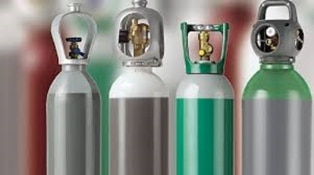 | CYLINDER SAFETY CAP EMPTY HIGH PRESSURE SEAMLESS CYLINDERS ₹8000 We are engaged in offering Industrial Cylinder to our clients. Cylinders are an integral part of the all Units. View product → |
Keywords